Point of impact
What is POI?
The point where the centre of the shot string is in relation to the aim point at a specified distance.
Pointing a gun and pulling the trigger doesn't help if you have no idea where the bullet or pellets will go.
With a rifle you can adjust the sights to compensate for the fall of a bullet over distance.
With a shotgun we don't have "sights" and we don't "aim", we "point". Our concentration must be on the target, not on the end of the barrel and certainly not on the bead.
What's the point of the bead?
We often see people experimenting with different beads - some seem downright silly!
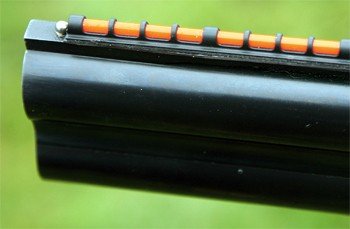
We don't aim our shotguns, we point them!
What we are looking for is a "sight picture" - the image of the action and rib in relation to our field of view when the gun is mounted.
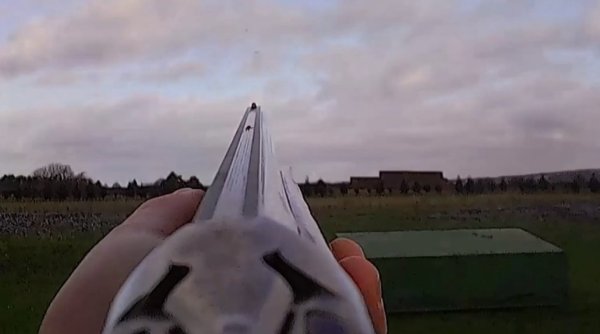
There are two important things about the sight picture:
- It must be consistent, every time, without thinking, without looking - it must just be there!
- It must be forgotten so that 100% of attention can be on the three most important things in clay shooting: "the target, the target and the target" - to quote George Digweed - and he should know!
It can be argued that the bead forms part of the sight picture to aid the brain in sub-consciously getting it right in your peripheral vision - time after time after time.
It can also be argued that beads should be filed off so there is no temptation to "aim". The moment you "aim", the moment your eyes focus on the bead or the rib, is the moment you miss - because you can't focus on the bead and the target at the same time!
Shotgun shooting is about "gun awareness" - the gun becomes part of you, like driving a car or riding a bike - and that takes time and practice. Over time, if your gun mount is consistent, the sight picture becomes intuitive so you can forget about it and concentrate on the target.
You can experiment with beads if you wish (it adds to the fun!) but it's worth remembering that George Digwood does just as well with an off-the-shelf Baikal as with a Perazzi! You just have to be a damn good shot - and that comes with some natural ability, a good coach and lots of practice - which DryFire can provide.
So, where is our gun pointing?
It depends.
Different guns point at different places. Some point straight ahead of the rib line, some point higher.
Sporting guns tend to shoot "flat" with about half of the pellets above and half below the point of aim. This is because sporting targets can be unpredictable
Trap guns tend to point higher to put the majority of pellets higher than the point of aim - at a specific distance. This is because trap targets are rising and we want the clay to fly into the shot pattern.
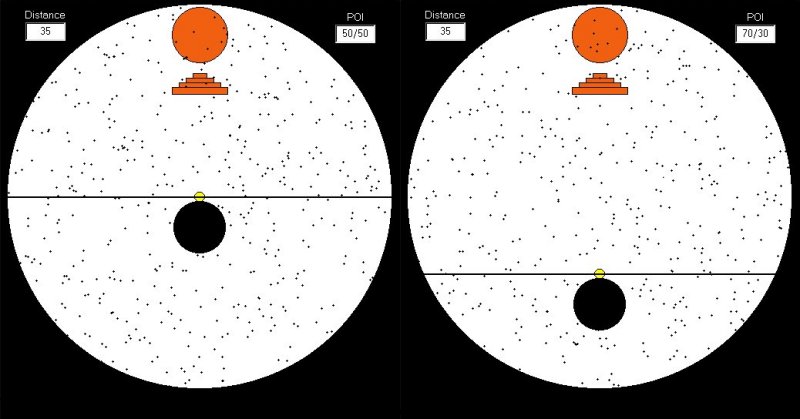
The diagram above shows 30" circles enclosing about 90% of the pellets at 35 yards.
The black circle with yellow bead (!) shows the point of aim. The clay is shown to scale: flat-on and edge-on.
The left image is a sporting gun and shows about 50% of the pellets above the point of aim and 50% below. This is referred to as a "50/50 gun".
The right image is a trap gun and shows about 70% of the pellets above the point of aim and 30% below. This is referred to as a "70/30 gun".
The pattern plate
The Teague Chokes web site has an excellent page on patterning.
The sketch below shows a simple pattern plate.
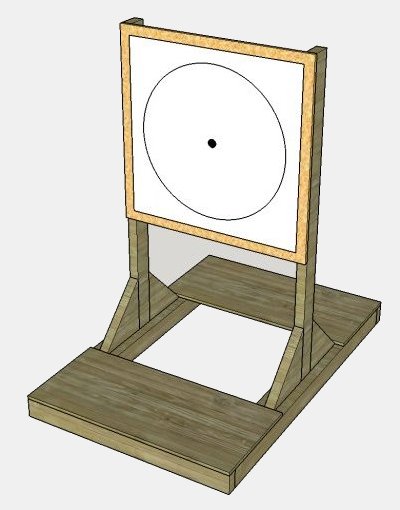
Many shooting grounds have a pattern plate to check point of aim. The sketch shows one with timber for the supports and replaceable chip board or MDF to hold the target. The centre of the board should be at the height of the average shooter when in the shooting position Obviously there needs to be a safe area behind the pattern board - rising ground or lots of space!
Using one is simple:
- Pin up a sheet of paper with a 30" (about 750mm) circle drawn on it and with the centre of the circle clearly marked so you can see it at about 35 yards.
- Stand back 35 yards and load a cartridge.
- Adopt your normal shooting position and point your gun at the centre of the circle as if you were shooting straight at a clay. Shoot.
- Count the number of pellet holes in the circle above the point of aim and the number below.
- POI = number of holes above / total number of holes * 100
E.g. 332 / 476 * 100 = 69.7% So this is a 70/30 gun.
- Try it a couple more times to make sure - you will need a fresh sheet of paper each time.
Point of Impact in DryFire
DryFire allows you to enter your POI as a percentage - you specify the first percentage as measured on the pattern plate, e.g. "70" for a 70/30 gun.
Alternatively you can enter how far the centre of your shot pattern is above your point of aim. You can do this by eye on the pattern plate.
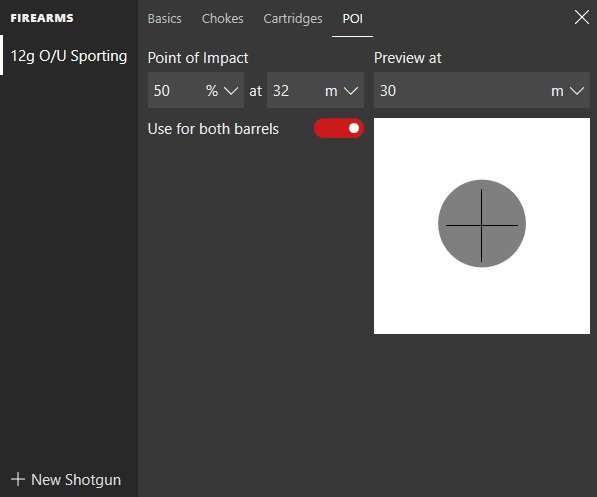
It is worth checking POI for each barrel. In almost all cases it will be the same for both but there are a few guns where the POI is different - the second barrel shooting higher than the first because the target will be further away! DryFire allows you to enter separate POIs for each barrel if necessary.